BrainTap
The $647 Lie-Down With Lights
There is something almost beautiful about the simplicity of relaxation.
You lie down.
You close your eyes.
You listen to something calming.
You stay there for twenty minutes.
This is not complicated.
Which is why the internet has been working very hard to complicate it.
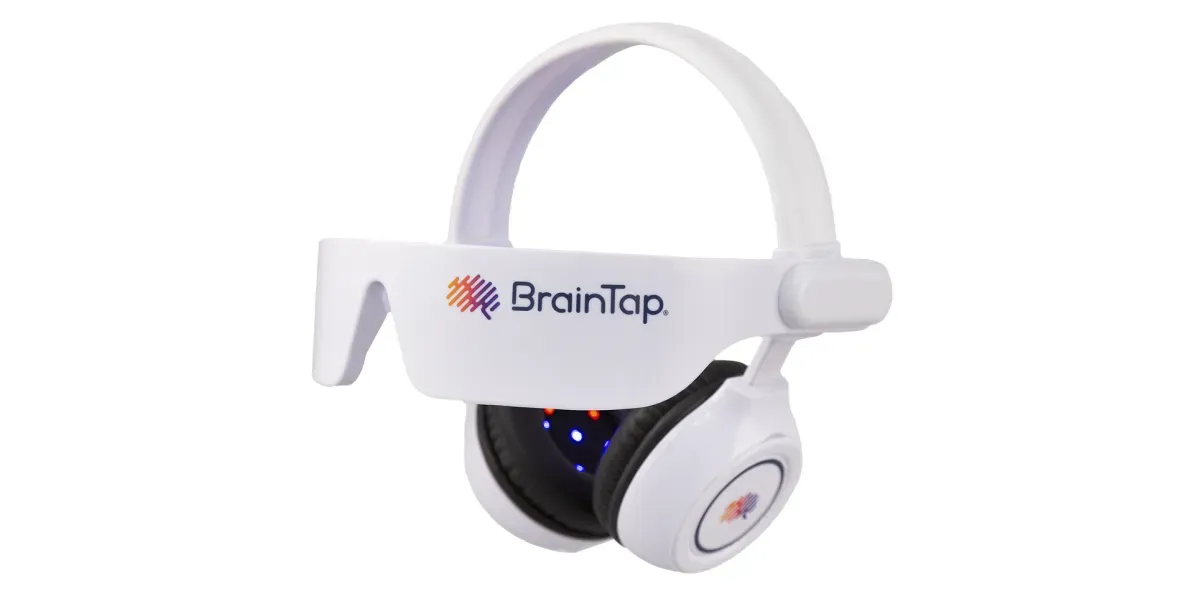
BrainTap is a system built around an app and a headset. The app costs $29.99 a month (about £24 for those of us on this side of the Atlantic). The headset costs $647, call it £520, and that is before shipping, taxes, and the quiet sense that you may have made a mistake. The headset has lights.
Not decorative lights.
Not ambient lights.
Pulsed lights.
Lights aimed near your eyes, and, according to the product literature, at something called the ear meridians.
The headset is also, according to the listing, final sale.
That means you can buy it. You can use it. You can decide it has not changed your life. You cannot return it.
This feels like an important part of the business model.
The Problem With Ordinary Relaxation
The problem with ordinary relaxation is that it is terribly hard to monetise.
A person lying quietly in a dark room is no use to anyone.
They may be improving their mood, regulating their breathing, reducing stress, and giving their nervous system a small chance to stop screaming, but nobody is getting a monthly subscription out of it.
This is inefficient.
The modern wellness industry cannot leave a simple human act alone. Breathing becomes breathwork. Walking becomes a protocol. Drinking water becomes hydration optimisation. Sitting quietly becomes mindfulness, then meditation, then neuroplastic recalibration, then something involving a headset, an app, and a checkout page.
BrainTap sits very comfortably in this world.
It takes guided relaxation, adds pulsed light, wraps the whole thing in language about brainwaves, neuroplasticity and frequency, then sells it as a technology.
The act itself is familiar. The packaging is the innovation.
You are no longer listening to a recording.
You are BrainTapping.
This is important, because once an ordinary thing has a branded name, it becomes much easier to charge $647 for the accessories.
The Headset Has Lights
The basic process appears straightforward. You choose a session from a library of pre-recorded audio programmes. You put on the headset. The audio plays. The lights pulse. You are encouraged to relax, focus, and become a slightly improved version of yourself.
This may well be pleasant.
In fact, I would expect it to be pleasant. Lying still for twenty minutes while a calm voice tells you to relax is often pleasant. Doing it with your eyes closed in a quiet room is also pleasant. So is not reading the news.
Hypnosis and guided relaxation are not nonsense. They can help people in certain contexts. There is research supporting hypnosis as a useful tool for relaxation, pain management, and behaviour change when used appropriately.
That is not the same as proving that a $647 headset with pulsed lights produces superior results to listening quietly to a recording in the dark.
This is the clever part.
BrainTap does not have to claim that relaxation is fake. It does the opposite. It borrows credibility from real practices. Hypnosis exists. Guided audio exists. People can become calmer when they relax.
Then the device arrives beside those facts and quietly places a shopping basket underneath them.
The question is not whether people can relax using BrainTap. Of course they can. The question is whether the expensive, non-returnable light-emitting headset is necessary for the relaxation, or whether it is accompanying something that was already doing most of the work.
There is a difference between a tool and a costume.
Ear Meridians and Other Useful Phrases
One of the bolder claims around the headset is that the lights are delivered not only to the eyes, but also to the ear meridians.
Ear meridians are not anatomical structures in the usual medical sense. They belong to the world of auriculotherapy, where points on the ear are said to correspond to different parts of the body.
This may sound meaningful. It may also sound like someone looked at an ear and thought, "This needs a map."
The usefulness of the phrase is obvious. It gives the headset a second layer of mystery. If the eyes are not enough, there are also ears. If the ears are not enough, there are meridians. If the meridians are questioned, the conversation can move smoothly to energy, frequency, and ancient wisdom.
This is how a lot of wellness language works. It does not have to explain itself fully. It just has to sound as though explanation exists somewhere nearby, probably in a PDF, possibly behind a login.
BrainTap also uses language such as brainwave entrainment, neuro-algorithm, rewiring, attuning the brain, and optimising mental states.
Some of these terms point towards real areas of study. Some are proprietary fog. The useful thing about proprietary fog is that it gives the impression of precision without allowing the customer to inspect the machinery too closely.
A calm voice in your ears becomes an audio programme. A flashing light becomes photic stimulation. Lying down becomes a session. The session becomes a system. The system becomes $647.
The Gwyneth Effect
Gwyneth Paltrow has apparently used BrainTap and called it amazing.
This is not surprising. Gwyneth Paltrow has made an entire commercial ecosystem out of the idea that ordinary bodily experiences become more profound when routed through expensive objects and a certain Californian mist.
She does not merely endorse products. She grants them entry into a particular world, a world where wellness is softly lit, lightly scientific, reassuringly expensive, and almost certainly delivered in neutral packaging.
For the right audience, "Gwyneth uses it" is not a detail. It is the clinical trial.
A celebrity does not need to prove the mechanism. They only need to appear as someone who has already crossed the bridge you are standing in front of.
She is calm. She is glowing. She has the headset.
Perhaps the headset is why. Perhaps it is also the money, staff, lighting, nutrition, genetics, and the fact that nobody is asking her to find the spare batteries.
The product listing does not clarify this.
Final Sale
The final sale part deserves more attention than it usually gets.
BrainTap is not selling a kettle. If you buy a kettle and it does not boil water, you know fairly quickly. There is a test. Water goes in. Heat happens. Tea becomes possible. Or it does not.
Sleep, stress, habits, mood, focus, confidence, and cognitive improvement are not like that. They are slow, slippery outcomes. They depend on everything. Diet, health, work, worry, grief, money, pain, noise, age, weather, marriage, loneliness.
So when a product promises changes in these areas, the user needs time. You may need weeks to decide whether your sleep is genuinely better. You may need months to know whether your habits have changed. You may not know whether the headset helped, whether the audio helped, whether the act of setting aside time helped, or whether your life simply became slightly less terrible for unrelated reasons.
By the time you work it out, the return window would normally have closed.
In this case, it never opened.
Final sale is presented as a retail condition. In context, it looks more like a philosophy.
You have made your decision. They have made theirs.
The Affiliate Opportunity
There is also an affiliate programme.
If you recommend BrainTap through a personalised link, the commission is 35%. Thirty-five per cent of $647 is $226.45. That is a significant incentive wrapped around a product that is difficult to evaluate and impossible to return.
People can genuinely like things and recommend them. They can also genuinely like things that pay them $226 a time. Human motivation is rarely clean enough to put in a display cabinet.
A product that is difficult to evaluate, expensive to buy, impossible to return, and profitable to recommend is not just a product. It is a recruitment surface. Every satisfied user can become a salesperson. Every salesperson can sound like a satisfied user.
The internet does not always lie directly. Sometimes it just arranges the incentives so that sincerity and salesmanship wear the same cardigan.
The Real Product
The appeal of BrainTap is not difficult to understand.
People are tired. People are anxious. People are sleeping badly. They want to change habits, calm their minds, feel more in control, and believe that improvement is still possible.
There is nothing foolish about wanting that.
The best wellness marketing does not invent the pain. It finds the pain, names it, validates it, and then leads it gently towards a payment form.
BrainTap offers structure. It offers ritual. It gives rest a container and self-improvement a device. The free version of all this is available to anyone: lie down, stop scrolling, listen, breathe, do it again tomorrow.
For many people, that would help. It would also be a terrible business.
The Lights Were Never the Point
The internet keeps taking simple, useful things and making them feel incomplete until they have been branded, technologised, bundled, subscribed to, optimised, and sold back to us with a testimonial.
Relaxation becomes a headset. Attention becomes a protocol. Sleep becomes a programme. Breathing becomes a course. A quiet room becomes an under-monetised opportunity.
BrainTap may help some people relax. I have no difficulty believing that. If I lay in a darkened room for twenty minutes while a calm voice told me I was safe, I might relax too, unless Larry chose that moment to sit on my chest and perform an unscheduled wellness intervention.
The issue is not whether relaxation happens. The issue is what has been built around it. The app. The headset. The lights. The language. The final sale. The affiliate commission. The suggestion that ordinary rest is no longer enough unless it arrives through a proprietary system and costs enough to make you take it seriously.
That may be the real mechanism. Not the light pulses. Not the ear meridians. Not the neuro-algorithm.
The price.
A free recording feels disposable. A $647 headset feels like a commitment. Once you have paid that much, you are no longer just relaxing. You are participating in your own transformation. You have invested. You have joined the sort of person who owns equipment for calming down.
This is how the wellness economy turns hope into hardware.
Lie down. Close your eyes. Listen to something calming.
You have just completed a session.
The lights were never the point.
Steve the Hypothetical Gerbil says he achieves relaxation by sitting in a dark corner of his nest on some shredded newspaper and doing absolutely nothing. He has not yet described this as a protocol, although several people on the internet would like him to. He also notes that his method is free, requires no batteries, and comes with a 100% satisfaction guarantee, because he is a gerbil and his expectations are appropriately calibrated.