Clear Your Cookies Before the Price Tag Starts Sniffing
How surveillance pricing uses your data to guess your pain point
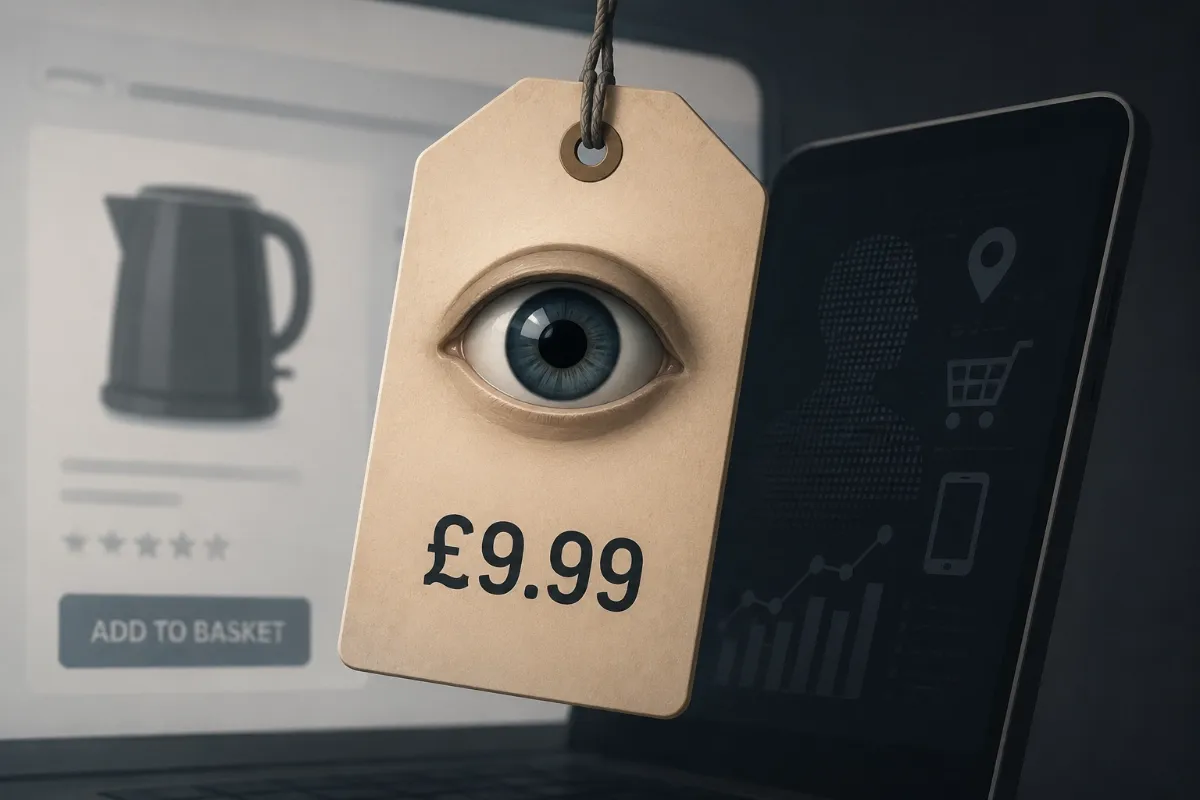
Once upon a time, a price tag was a small piece of cardboard with £9.99 written on it. It had one job. It sat there, quietly, telling everyone the same thing. Rich man, poor man, woman in a hurry, bloke comparing kettles for the fourth time that week. Everyone saw the same little rectangle of retail certainty.
You could trust it to be boring. That was the charm.
Now the price tag has eyes. It knows where you came from, what you clicked, what you abandoned in your basket, what device you are using, where you live, how often you return, and possibly whether you are the sort of person who buys things at 1.37 in the morning after reading three articles about fixing your life.
Online shopping is starting to feel less like commerce and more like being watched by a cash register with opinions.
The official phrase is personalised pricing, or, in its creepier and more honest form, surveillance pricing. A company uses personal data to estimate how much you, specifically, might be willing to pay. The price you see may not be the price someone else sees. It may be the retailer's best guess at your private pain point.
This is not science fiction. On 19 August 2026 the US Federal Trade Commission proposed an enforcement policy on personalised pricing, warning that companies may need to tell consumers when a price has been set using their personal data, what data was used, and why. FTC chair Andrew Ferguson put it plainly: when consumers see a listed price, they expect it to be the price everyone else sees, not the retailer's estimate of how much they are willing to pay.
That expectation suddenly feels rather quaint. Like the chip shop charging you extra because you look hungry.
Dynamic pricing was bad enough
Prices have always moved. Airlines, hotels, trains, supermarkets. A hotel room costs more during a festival. Strawberries get cheaper when they are about to lose the will to live. A flight to Malaga becomes mysteriously expensive the moment school holidays begin. Annoying, but at least the insult is shared.
Dynamic pricing says demand is high, so the price has gone up. Personalised pricing says we think you will pay more. One looks at the market. The other looks at you.
That is the line worth watching, because once the price is personalised, the old public price tag starts dissolving. You are no longer shopping in quite the same market as everyone else. You are negotiating with a machine that has read your file, while you are not allowed to see its notes.
Wonderful. Just what shopping needed. A parole board.
What the machine might know
The FTC has been studying what it calls the shadowy market of third-party pricing intermediaries since 2024, when it ordered eight companies to hand over information about their surveillance-pricing products. Its staff reported back in 2025 that these systems can draw on your location, your searches, what you bought, what you nearly bought, the device in your hand, whether you arrived from an advert, whether you keep coming back, and how much people like you usually spend. Roughly speaking: whether you look urgent, loyal, tired, panicked, or rich enough not to bother checking elsewhere.
The phrase that keeps appearing in these discussions is willingness to pay. That sounds like economics. It also sounds like a shop assistant leaning across the counter and whispering: we reckon you can take another £12.
A House Oversight inquiry was blunter still. In March this year, the committee wrote to Booking, Expedia, Uber, Lyft and Instacart demanding answers about algorithms that are fed harvested personal data and used to work out a consumer's emotional state, purchase intent, and maximum willingness to pay, or, in the committee's own quoted phrase, their "pain point."
Pain point. You have to admire the honesty, in the same way you admire a burglar who labels his crowbar.
Europe got there first. It still wasn't enough
None of this will surprise Brussels. The EU has had personalised pricing on the worry list since at least 2018, and since May 2022 the Consumer Rights Directive has required traders to tell you when a price has been personalised using automated decision-making. That is, almost word for word, the rule the FTC has just proposed. Europe is four years ahead of Washington.
But notice what the European rule actually requires. The seller must admit the price was personalised. It does not have to say how, or why, or using which data. The price tag has to confess to sniffing. It does not have to say what it smelled.
GDPR offers a second, theoretical shield on top: Article 22 says you cannot be subjected to a purely automated decision that significantly affects you, and regulators' own guidance suggests differential pricing could qualify. The trouble is that nobody has ever tested it against a price tag, and the article carries exceptions for decisions "necessary for a contract" or made with consent, a hole wide enough to drive a checkout through. A shield that has never been raised in anger is a poster of a shield.
Brussels knows this. The Digital Fairness Act, due as a legislative proposal later this year, is the EU admitting that mandatory confession was not enough, with talk of opt-outs from personalised offers and limits on pricing that targets grief, distress or vulnerability.
Four years of compulsory honesty, and the honest conclusion is that honesty alone did not fix it. Worth remembering when anyone tells you disclosure is the answer.
The cookie banner was trying to tell us something
For years, refusing cookies felt like privacy theatre. You clicked reject all, the website sulked, and everyone carried on. A small, weary act of digital hygiene, like closing the curtains before wandering around in your pants.
Now it may also be an act of price hygiene. If your browsing history, habits and location help decide what number you see, tracking has moved past advertising and into the price itself. A targeted advert is irritating. A targeted price is personal. The advert says we saw you looking at walking boots. The personalised price says we saw you looking at walking boots three times, noticed you are leaving for Wales on Friday, and have adjusted our expectations accordingly.
At that point, refusing cookies stops being paranoia and starts looking like refusing to hand the shopkeeper your diary. Even the FTC seems to agree. Its proposal notes that consumers who knew their data was setting their prices might start using private browsing and VPNs, or take their custom elsewhere. When the regulator's own paperwork recommends the tinfoil, the tinfoil has gone mainstream.
The guru funnel will love this
For ordinary retail, personalised pricing is worrying enough. For the grift economy, it could be spectacular.
Think about the classic online funnel. A person watches a video called Why You're Still Poor After 50. They click an advert, land on a page for a wealth reset masterclass, watch a webinar, abandon the checkout, come back the next day, open three emails, and sit through a testimonial from a man who claims to have built a passive-income business while recovering from burnout in a hammock.
Now imagine the price at the end of that funnel is not fixed. Imagine the system knows, or thinks it knows, that this person is older, has clicked debt-related content, watches videos about retirement anxiety, came back after midnight on an expensive device, hesitated at £297, and might stretch to £897 if the programme is renamed Executive Mentorship.
The fake guru already tests headlines, colours, testimonials, urgency timers and only-three-spaces-left messages. Letting the price itself respond to the victim's profile is the natural next step. The old scammer had to guess what kind of mug you were. The new website can ask the database.
Discounts will be the defence
Companies will not describe any of this as squeezing people. They will call it personalisation. Some customers get discounts. Offers can be tailored. Loyal customers can be rewarded. Prices have always varied. Some of that will even be true, which is deeply inconsiderate of reality.
There are harmless versions. A student discount is personalised. A pensioner discount is personalised. A loyalty-card offer on cat food because you always buy cat food is not, by itself, the fall of civilisation. The problem comes when the system is secret, individualised and one-way. You do not know whether you are being rewarded, nudged, punished or rinsed. You see a number. The company sees a probability model. That is a poker game in which the dealer can see your cards, your bank balance, and the fact you searched how long do kettles usually last ten minutes ago.
The vanishing public price
A public price has a strange democratic usefulness. It lets people compare. It lets them complain. It lets them notice when something is too expensive. Personalised pricing dissolves that reference point. If everyone sees a different price, nobody knows what the thing costs. You only know what the system thinks you cost.
It also makes ordinary consumer advice weaker. Shop around still helps, but only if you can see comparable prices. Clear your cookies may help, but only if the company has not already matched you through login data, device fingerprinting, loyalty accounts, email tracking or data bought from elsewhere.
This is why the FTC's disclosure idea matters. If a company is using your personal data to decide your price, it should have to say so clearly. Not in a privacy policy written by a committee of sedated lawyers. Not behind a link labelled Your personalised experience. Clearly, before you pay, in words short enough to make the marketing department cry.
Worth being honest about the limits, though. The FTC itself concedes it does not have the legal authority to ban personalised pricing outright, admitting that Congress has never given it the power, which makes disclosure the whole remedy on the table, not the opening bid. And Europe's four-year experiment suggests what a confession-only rule is worth.
Nor is Washington acting alone. Maryland and Connecticut have surveillance-pricing measures taking effect this October. New York's One Fair Price Act passed its legislature in June. New Jersey has banned personalised algorithmic pricing for groceries. The FTC has joined a parade already halfway down the street.
What you can actually do
I would love to end with one perfect fix. There is not one. Sorry. I looked behind the sofa and everything.
There are small defensive habits, though. Refuse unnecessary cookies, clear your browsing data now and then, compare prices in a private window or from a second device, and stay logged out until you actually need to be logged in. Be especially suspicious of course funnels, wellness subscriptions, travel bookings, limited-time offers, abandoned-basket emails, and anything that appears to know exactly how uncertain you feel. None of this makes you invisible. It just makes you slightly less convenient to price individually. In a world where the price tag has started sniffing, inconvenient may be the best available thing to be.
Where that leaves us
The real shift is that retail is moving from the price of the thing to the price of the person. A product with one price can be judged. A product with a different price for every customer is harder to inspect, harder to compare, harder to challenge. The old price tag said this is what it costs. The new one says this is what we think we can get out of you.
Clear your cookies. The till is taking notes.
Steve the Hypothetical Gerbil confirms that in his shop, seeds cost the same whoever is buying them, mostly because he cannot tell humans apart. He clears his own cookies. Then eats them.