How to Sell Someone the Instructions for Selling Instructions
The First Sale System

Steve the Hypothetical Gerbil's summary, for those in a hurry: A Medium confessional leads to a Gumroad page selling AI prompts that generate the exact kind of digital product the Medium confessional was written to sell you. Both come with a "proof" screenshot. The two screenshots are the same screenshot. I have seen better-constructed nests made from a single sock.
There is a particular kind of internet specimen that doesn't sell you a product so much as sell you the idea that selling products is easy, and somewhere underneath several layers of that idea, if you keep excavating, there is usually nothing at all.
Today's find is one of the cleaner examples I've come across, mostly because the person doing the digging left the shovel in the hole, twice, in two different places.
The Medium Article
It starts on Medium, with a headline built for maximum flinch: I Wasted Months on 4 AI Side Hustles. The Fifth Made $12,248 in 5 Months.
The author, Rama Khalifa, walks us through the failures first, and to be fair, this part is well observed.
The faceless YouTube channel demonetised for "inauthentic content."
The freelance writing gig that ended when a client wrote back, "This reads like a robot wrote it. I can tell."
The Etsy shop full of AI wall art that made $9.98 before fees.
The dropshipping store that lost $186 and, more memorably, a customer's faith in humanity.
Four failures, four small deaths, competently written. I have no argument with any of it. It probably happened.
Then comes hustle number five, the one that worked, and the piece pivots from confession to something else entirely.
A friend asks a leading question over coffee.
A lightbulb goes on.
Rama builds a Notion content calendar template, sells it on Gumroad for £27, cries a little at the first sale.
Lovely stuff.
And then, right in the middle of the emotional high point, tucked into a single sentence like a burr in a jumper, there it is:
"I turned this into a full system so you can follow along, if you want to go deeper it's here."
That sentence is the only reason the other 1,400 words exist.
Everything before it is scaffolding.
The Product Page
Follow the link and you land on a Gumroad page for something called The First Sale System. €21.90, or $25, or $15 if you're one of the first ten buyers, the currency apparently as negotiable as the truth.
It promises five "pre-mapped" digital products, a launch kit, and, this is the part worth sitting with, six copy-paste AI prompts for building "your actual product files."
In other words, the system being sold is a machine for producing the exact type of thing that produced the Medium article that sold you the system.
It is prompts, for making prompts, to write about making things with prompts.
Somewhere at the bottom of this stack, presumably, is an actual Notion template, small and confused, wondering how it got there.
Two Screenshots, One Chart
The numbers don't hold together, which is the sort of detail that always turns up once you stop being dazzled by the round figures.
The Gumroad page claims $10,000 across four months, from 527 sales.
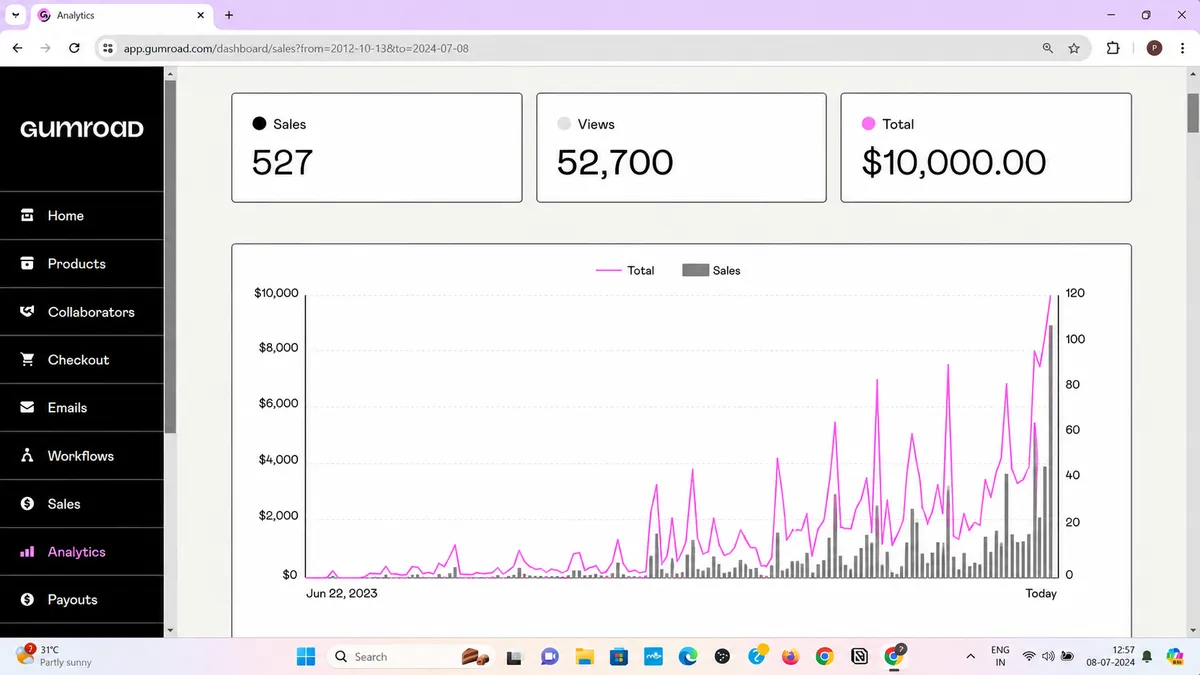
The Medium article, sitting right above the sentence that links to the Gumroad page, claims $12,248 across five months, from 645 sales.
Two different totals for what is supposedly the same product's track record is odd enough on its own.
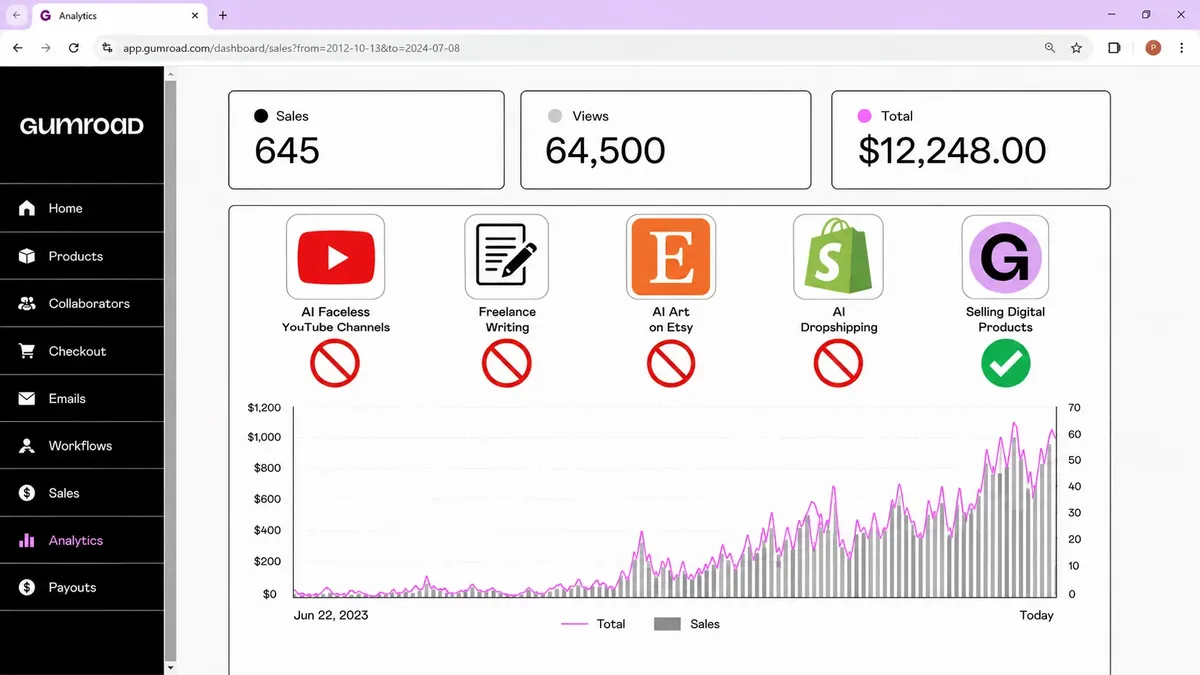
But the two dashboard screenshots supplied as proof of each figure share an identical URL, app.gumroad.com/dashboard/sales?from=2012-10-13&to=2024-07-08, a date range nobody sets on purpose, and an identical start point on the graph itself: 22 June 2023.
Put the two charts side by side and the line does the same thing in both.
Flat for the first two thirds, a ragged climb, a sharp spike right at "Today." Same shape, different y-axis.
One is scaled to peak at $10,000, the other at $1,200 per bar with a total headline of $12,248.
It is the same graph, rescaled and relabelled, deployed on two platforms to support two different claims.
The Medium version adds a flourish the Gumroad version doesn't need: a row of five icons along the top, one for each hustle, four with red prohibition signs and the fifth given a tidy green tick.
It is doing the verdict for you before you have read a word, which is the sort of thing that takes about four minutes in Canva and a great deal longer to earn honestly.
Both screenshots, whatever they actually document, are timestamped over a year before this particular product existed.
The taskbar clock in the Gumroad-page version reads 8 July 2024.
The First Sale System launched with a 48-hour countdown and a vanishing discount code sometime after that.
Whatever this dashboard is a record of, it isn't a record of this.
And then there's the views.
The Gumroad screenshot shows 527 sales against 52,700 views.
The Medium screenshot shows 645 sales against 64,500 views.
Work out the conversion rate on each and you get 1.00%, both times, to two decimal places.
Real traffic doesn't behave like that. Genuine view counts drift, they're noisy, they don't land on a tidy round ratio twice running in two unrelated snapshots taken months apart.
The only way to get 1.00% twice is to never have measured the views at all, and instead take whatever the sales figure happened to be that week and multiply it by a hundred.
The funnel wasn't observed. It was built backwards from a number Rama had already chosen.
The Same Date, Twice
None of which means Rama didn't make some money. People do make money selling digital products, in the dull, unglamorous way that people make money doing most things, by understanding a problem and building something that solves it competently. The template might even be a perfectly good template.
But that isn't really what's being sold here.
What's being sold is the feeling of having found the shortcut, wrapped in a confessional that borrows the emotional shape of failure and redemption, backed by a screenshot doing double duty under two different names, priced with a countdown timer on a digital file that will still exist, unchanged, in exactly the same quantity, next Tuesday.
The tell, as ever, isn't that it looks like a grift.
It is that it's structured like one: a story that exists purely to deliver a link, a product that teaches you to build the product that sold it to you, and proof that turns out to be the same piece of proof, reused, restyled, and asked to swear to two different things at once.
The first half was the trap.
The second half was the spring.
And the screenshot, both of them, was the same date.
Steve's note: I tried to trace where the actual $10,000, or $12,248, or whichever figure we're using today, actually went, and got lost somewhere around the third pre-mapped product. I am a hypothetical gerbil, not an auditor. I know my limits.
This is one product out of several. There's a bigger one coming tomorrow, same author, more receipts, and honestly, worse arithmetic.
Paul's note: What gets me isn't the hustle. It's the honesty of the first half being used as bait for the dishonesty of the second. If you're going to lie to me, at least have the decency to lie all the way through, and maybe take two separate screenshots while you're at it.
The original Medium Article