Niche Work If You Can Get It
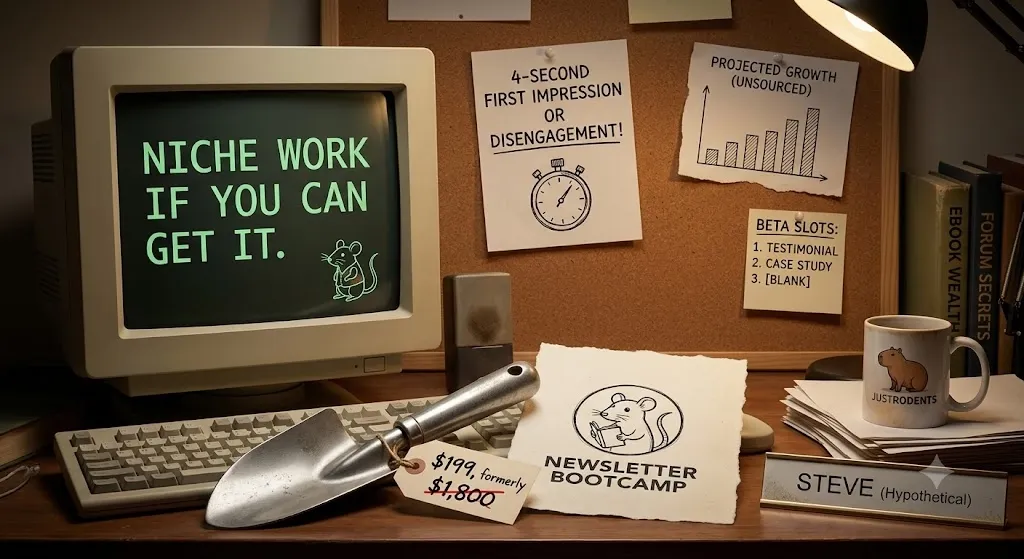
Steve’s TL;DR: A newsletter about newsletters offers free advice on choosing what to write about, then reveals the real problem is your logo, which can be fixed for $199, reduced from a retail price that has never existed. Steve remains, as ever, hypothetical, which is more than can be said for some of the credentials below.
Somewhere around 2005 I spent more time than I’ll admit on the Warrior Forum, watching people sell each other guides on how to make money selling guides. The products changed every few months. The structure never did. You gave away something reasonable for free, you manufactured a problem the free thing couldn’t solve, and then you sold the shovel. Twenty years on, the shovel shop has moved to Substack, and it’s had a lovely rebrand.
The specimen that landed in my feed this week is a long, genuinely readable post about choosing a profitable newsletter niche. And here’s the thing I want to say before the knives come out: the advice is fine. Pick a specific audience rather than a vague category. “Wellness” is a shelf, not a promise. Attach a person and a problem to your topic and readers can picture what they’re subscribing to. None of this is wrong. None of it is new either. It has been circulating since the ebook era wore its first waistcoat, but recycled sense is still sense. If the post ended there, it would just be a decent free resource, and this essay wouldn’t exist.
It doesn’t end there. It pivots, and the pivot is where the anatomy gets interesting.
After two thousand words on finding your niche, the post announces that your niche won’t save you. Your real problem, apparently, is one you’ve been avoiding: your visuals. Readers form an impression in four seconds. Thirty-eight per cent of visitors, we’re told, disengage the moment a page feels unconsidered. No source is given for either figure, and the four-second claim is helpfully described as “not a marketing exaggeration”, which is the sort of sentence that only ever appears next to a marketing exaggeration. The section is even titled “The part nobody admits”. You have been softened up with sensible advice for the length of a sermon. Now comes the diagnosis, followed immediately, by pure coincidence, by the cure.
The cure is a brand identity package, and the pricing is where I’d invite you to slow down and read carefully. The entry tier costs $199, “retail $1,800”. The middle tier is $599 against a retail of $3,999. The top one starts at $1,999, marked down from $6,999 and up. Impressive discounts. There’s just one difficulty, stated plainly in the post itself: this service has never been offered before. It’s a beta. Nothing has ever been sold at the retail price, because the retail price was born the same afternoon as the discount. You cannot reduce a number that has never been charged. What you can do is invent a large number, place it next to a smaller one, and let the reader’s brain do the maths on your behalf. In the trade this is called anchoring. In my street in Swansea it was called telling fibs about what the TV cost before the sale.
Then there’s the beta itself. Three spots only, at the reduced price, “in exchange for a detailed testimonial and case study consent”. I’ve spent a year now looking at sales pages built on walls of glowing testimonials, and it’s oddly moving to see the harvest at planting season. This is where those quotes come from. Not from delighted customers who spontaneously wrote in, but from a contractual arrangement made before any work existed, priced into the discount. The testimonials you’ll read next year were purchased this week.
None of which is unusual for the genre. What lifts this specimen into the display cabinet is the final paragraph, where the author, apologising for a publishing hiatus, explains she’s been juggling university and a new internship. Scroll up a few hundred words and you’ll find the credentials underpinning the $6,999 retail tier: six years of freelance brand design and more than seventy clients. Both statements sit in the same document, forty lines apart. I’ll leave the question of when those six years began as an exercise for the reader, but I’d suggest doing it before the four seconds are up.
Then there is the recursion. This is a newsletter about newsletters, selling branding for newsletters, to people who found it by reading newsletters about newsletters. Listing possible niches, the author suggests “newsletter writing for other newsletter writers” and concedes it is “admittedly a bit meta”. Reader, she is describing her own reflection and does not appear to have noticed the mirror.
Here’s the quiet tell, though, the same one every specimen in this series shares. The post contains twenty-two niches, six formulas, three filters and a downloadable list of two hundred and forty ideas, and not one sentence on the only question that matters: how does anyone find your newsletter once you’ve written it? Ideas are free. Positioning is free. I’ve just summarised the whole lot in a paragraph, also free. Distribution, the actual asset, the thing that separates a newsletter from a diary, goes unmentioned, because it can’t be put in a PDF. The one thing you’d pay for is the one thing never for sale.
I want to end gently, because this is not the worst offender in the cabinet. Nobody’s diabetic grandmother is being harmed here. This is a student running the oldest and softest hustle in the catalogue, selling shovels beside a gold rush, and for all I know the design work is perfectly good. She may look back on the invented retail prices with a wince, the way I look back on my my old pet websites, a story for another day. The point of the dissection isn’t the specimen. It’s the genre, which has survived unaltered from the Warrior Forum to Substack by doing exactly one thing well: finding people who want to be writers and selling them everything except readers.
Steve notes that he has never rebranded, his visual identity consists of being hypothetical, and his four-second first impression is entirely imaginary.
Retail value: $6,999.
Yours free.