The Advice Economy: How Selling Advice About Selling Became More Profitable Than Selling Anything Else
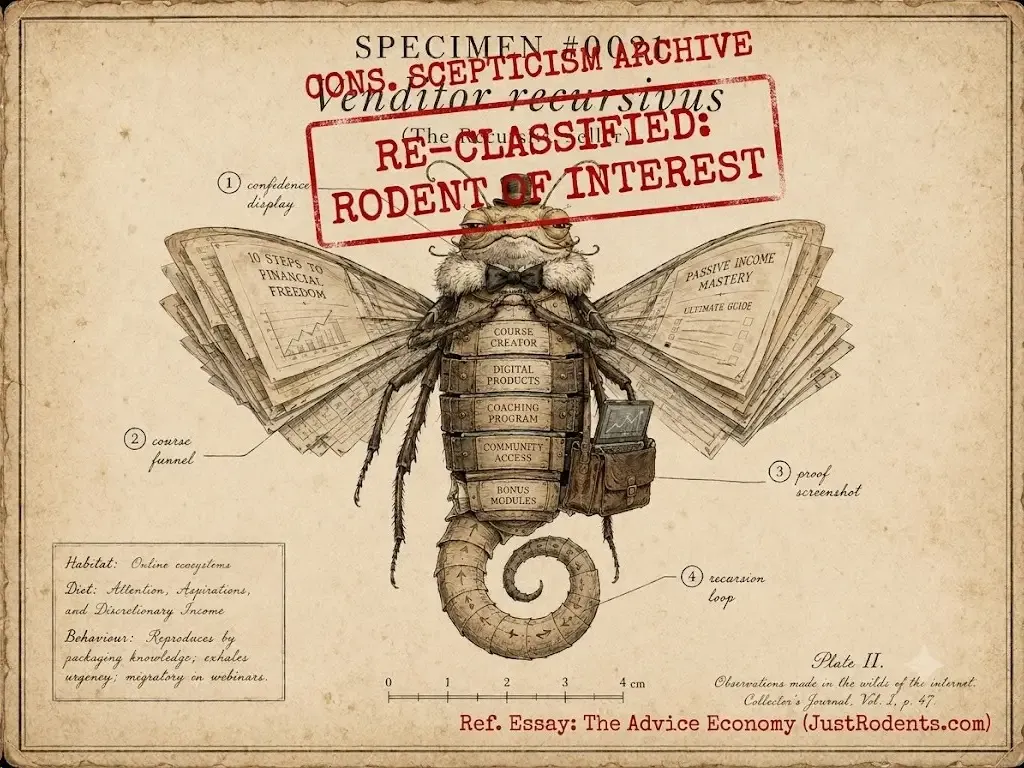
I've been reading posts on Medium.com again.
I know. I should know better by now. But it remains an excellent source of material for someone with my particular interests, which is to say, watching people sell things and thinking about what they're actually selling.
This week I found an article about using Pinterest to sell digital products on Gumroad.
The article contained three links to digital products on Gumroad.
The products taught you how to sell digital products on Gumroad.
The article was the funnel. The products were what the funnel sold. The products taught you to build the funnel that sold the products.
I sat with this for a moment.
What She Was Actually Selling
The author is a passive income coach. She sells three products:
- A toolkit of ChatGPT prompts for creating digital products ($37, no refunds).
- A set of Canva templates for designing ebooks ($29, no refunds).
- A guide to writing and selling ebooks ($21, no refunds).
The guide to writing and selling ebooks is itself an ebook. About writing ebooks. Sold on Gumroad. Promoted via an article about selling things on Gumroad.
This is not a coincidence or an oversight.
It is the entire business model.
The products teach you to do what she is doing. Which is selling products that teach you to do what she is doing. The pyramid doesn't announce itself. It simply invites participation.
The Advice Economy
What she's doing has a name, though it rarely gets called by it directly.
The advice economy is the ecosystem of people who make money by selling advice about making money. It's distinct from people who make money doing something and then share what they learned. The advice economy skips the doing entirely. The expertise is the act of selling the expertise.
It's not new. Self-help books have existed for over a century. Business coaching has been a profession for decades. But the internet, and specifically the combination of platforms like Medium, Gumroad, and Pinterest, has reduced the barrier to entry to approximately zero.
You no longer need a publisher, a speaking agent, or even a credible track record. You need a Gumroad account, a Canva template, and an article explaining how to use Pinterest to drive traffic to your Gumroad account.
The circle is complete before it begins.
The Recursion Problem
Here's what bothers me about it, and I've been trying to articulate this precisely.
It's not that the advice is wrong. Most of it isn't. Pinterest does function as a visual search engine. Evergreen traffic is real. Building an email list before depending on platform algorithms is genuinely sensible.
The problem is that the advice is being validated by the act of selling it rather than by the underlying activity it claims to teach.
If I want to know whether a particular approach to growing tomatoes works, I look at someone's tomatoes. If I want to know whether a particular approach to earning passive income from digital products works, I'm being asked to trust the person who is earning passive income by selling me advice about earning passive income from digital products.
The evidence that the system works is the system working. For her. By selling the system.
That's not evidence. That's a demonstration of something slightly different.
The No Refunds Detail
All three products are sold with no refunds.
I keep coming back to this.
The "name a fair price" button on each product implies generosity and flexibility. You can pay more if you feel the product is worth it. What you cannot do is pay less, reconsider, or recover your money if the product doesn't deliver what was suggested.
This combination, flexible pricing upward, no flexibility downward, is worth examining.
A person confident in their product's value tends to stand behind it. A money-back guarantee is not generosity. It is confidence expressed as policy.
No refunds is not a standard retail condition in the digital product space. Several major platforms offer them as a matter of course. The decision to withhold them is a choice.
What it communicates, alongside "name a fair price," is this: we believe you might pay more than the minimum. We do not believe you will want your money back. These beliefs are not symmetrical.
The Branding Kit
The Ultimate Ebook Branding Kit promises to help creators produce content that looks credible, modern, and high-value.
The product description spells "minimalistic" as "minmalistic."
Twice.
I'm not raising this to be unkind. Spelling errors happen. They happen to everyone, including me.
I'm raising it because the product is sold without the option of return, and because it promises professional credibility, and because the description of that professional credibility contains an error that a single proofread would have caught.
The absence of that proofread and the absence of a refund policy are related. Both suggest a product assembled quickly and released with confidence that the money will not be coming back.
What The Internet Did
I got online thirty years ago. One of the first things I found was the script of the Monty Python Dead Parrot sketch, stored on a server in Australia. I was in Italy. The idea that a joke could travel that distance, instantly, for free, felt like magic.
That internet was not trying to sell me anything.
The internet that exists now has built an entire economy around selling people the tools and knowledge to participate in the economy of selling people tools and knowledge. The layers have multiplied to the point where the original underlying activity, making something, learning something, building something real, has become almost optional.
You can earn a living in the advice economy without ever having done the thing you're advising on. You just need to have sold advice about doing the thing. The evidence of your expertise is the sale. The sale validates the expertise. The expertise justifies the next sale.
It's not a scam exactly. The advice often contains genuine information. The templates work as templates. The prompts do what prompts do.
But somewhere in the recursion, the connection between advice and experience has been severed. What's being sold is the appearance of a pathway rather than the pathway itself.
The 83 Sales
83 people bought the AI Hustler Toolkit.
35 people bought the Ebook Business Toolkit.
These are real people who paid real money, minimum $37 and $21 respectively, with no possibility of refund, for PDFs about making PDFs to sell to people who want to make PDFs.
I don't know their circumstances. Some of them may have found genuine value. Some may have been beginners who needed the structure. Some may have gone on to build something real from the prompts and frameworks.
But some of them, probably most of them, are people who wanted the pathway and got a map of the pathway drawn by someone who is primarily in the business of selling maps.
The map and the territory are not the same thing.
The map costs $37 minimum.
There are no refunds.
A Note
If you want the full clinical dissection of this particular specimen, including the Latin classification, the formal taxonomy, the glossary of terms, and the complete testimonial record from Cordelia, Fenella, Imogen, and Gerald, the specimen version lives on Vermin of the Internet.
Gerald, for what it's worth, has completed the full recursive cycle. He now sells a PDF about Pinterest on Gumroad. He has named a fair price. No refunds are available.
He has become the specimen.