The Boring System That Actually Works (On You)
The $24 Course That Teaches You to Sell the $24 Course
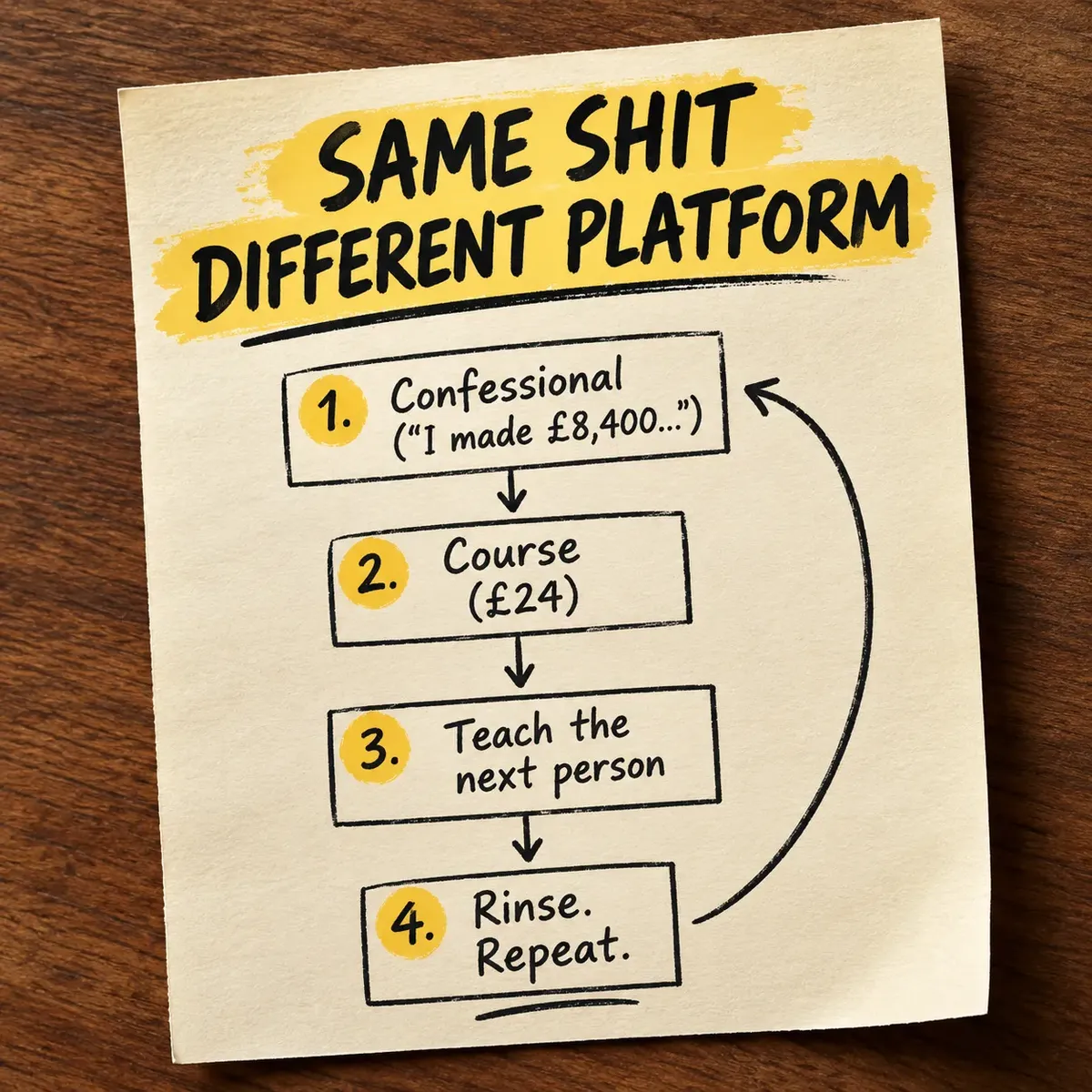
Steve's TL;DR: A Medium writer called Ivanka Finance says she made $8,400 in a month using "two free platforms" and a boring 30-minute habit. Follow the link at the bottom of her article and you land on a $24 guide selling you the boring habit. Module five of that guide teaches you to sell the boring habit to someone else. Nobody in this chain has shown a bank statement.
Two documents make up today's specimen. One is a Medium confessional titled "I Made $8,400 in 30 Days With Zero Followers." The other is the page it links to, a Payhip checkout dressed up as a course called Pin Income Blueprint. Read separately, they're both fairly ordinary examples of the genre. Read together, they're a complete circuit.
The bit that's true
Before getting into what's wrong with this, it's worth saying what isn't. Pinterest genuinely does function more like a search engine than a social feed, people go there with intent rather than to scroll, and that's a real and useful distinction for anyone trying to get found. Medium's Partner Program genuinely does pay out partly on reading time rather than raw views. Neither of these facts is invented. They're also not insights. They're things Pinterest and Medium have said about themselves in their own marketing for years, restated here as if they were discovered down a well.
The article
Ivanka Finance's story runs on the same chassis every entry in this genre uses. A friend quietly reveals a dashboard. Our narrator watches in skeptical silence for exactly three weeks before trying it herself. Week one is quiet and demoralising, week two shows "traction," week three brings "consistency," and by the end she's not starting from zero every morning. It's the same three-act structure as half a dozen other specimens on this site, down to the week-by-week beats, which suggests either a remarkably consistent lived experience across dozens of unrelated writers, or a template.
What's missing is the thing this genre used to at least fake: a screenshot. No dashboard, no payout notification, no graph with a suspiciously round number on it. Just the figure, stated once, and moved past quickly. That's not an oversight. Screenshots got this genre caught too many times, ours included, so the $8,400 simply isn't shown to anyone, which also means it can't be checked by anyone. Zero evidence is a strange upgrade on fake evidence, but it does mean nobody can pixel-peep the numbers apart the way we have with others.
The link at the bottom is worth pausing on too. It's hosted on GitHub Pages, which is free. A woman who claims to be pulling $8,400 a month is running her sales funnel off infrastructure that costs nothing and can be spun up in an afternoon. That's not proof of anything on its own, but it's a strange choice for someone with a business rather than a hobby.
The page
Click through and the "boring system" turns out to have a countdown timer. Fifty-nine minutes and change, ticking down to the moment the price "rises to $49." Refresh the page. It resets. There is no deadline. There's a clock.
Alongside it sits a claim that 834 women have already followed this exact system. Reload the page as many times as you like, it stays 834, which confirms it isn't counting anything, it's decoration. Further down the same page, the number reappears, only now it's 834 people, not 834 women. Nobody checked the two mentions against each other before publishing, because nobody needs to when the figure was never meant to move in the first place. There's a five star rating with nothing linked behind it. There's a testimonial from "P, Guide Creator," who has earned $68,000 selling Amazon and digital products on Pinterest, a figure offered with the same weight as the platform mechanics above, which is to say none, because nothing here is shown, only stated.
The course itself is five modules, and the second one promises to fix your "outbound click structure," a phrase that sounds like it means something until you notice it's never actually defined anywhere on the page. Strip the jargon out and the entire insight is: put a link in your pin description. Pinterest has worked this way since roughly 2013.
There's also a "this is not for you if" section, and it's worth reading closely, because it isn't filtering anyone out. "You want overnight results with zero effort" and "you're not willing to post consistently" are not descriptions of the person reading a sales page for a $24 guide at eleven at night. Nobody recognises themselves in that list. That's the point of it. It's not a filter, it's a mirror angled to flatter whoever's looking into it.
The recursive bit
Here's the part that makes this a proper specimen rather than just another thin PDF. Module five, the last one, is called Monetize, and it teaches you to send Pinterest traffic to "a Medium or personal blog, Amazon affiliate links, or your own digital products." Which is to say: having paid $24 to learn the system, you are then taught to build your own version of Ivanka Finance's Medium article, pointing at your own version of the Pin Income Blueprint page, aimed at the next person reading a confessional at eleven at night.
This is the same recursive shape we've documented here before, the technique used to sell the technique to people who will, if they follow the instructions correctly, use the technique to sell the technique onward again. Nobody in the chain needs to be lying, exactly. Everyone just needs to keep doing what module five tells them to do.
Steve's verdict
Steve has read the whole funnel twice now and still can't find a single number in it he can check. He'd like to see 834 receipts, not 834 claims. Until then, he's putting his own two hours a day into something with a marginally better return: digging.