The David Beckham Stack
When Real Science Becomes Luxury Supplement Theatre
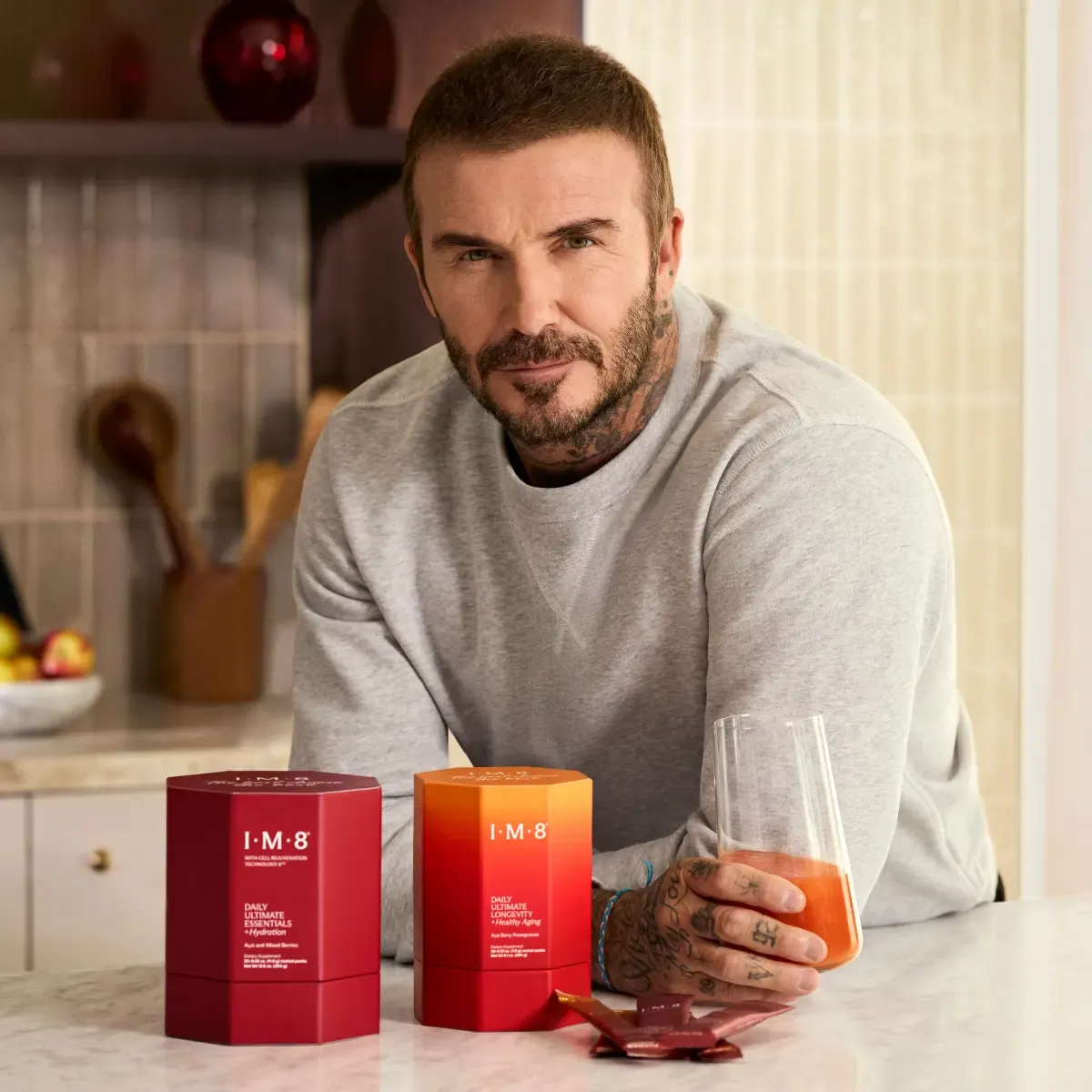
TL;DR (Steve says): IM8 is not fake. That is what makes it interesting. It is a real company, with real credentials, real ingredients, and at least some real science behind it. But the marketing wraps that reality in pricing gymnastics, ageing mysticism, and a commissioned clinical trial presented with the glow of independent research. Steve checked. Steve remains spiritually unconvinced.
Verdict: real science, laundered through unfalsifiable ageing language and a commissioned study wearing an independent trial's clothes, sold at a price that assumes you will not check either.
There is a version of this article that would be easy to write.
It would involve a fictional doctor, a Shenzhen return address, a miracle tub, and a Trustpilot review that vanished the week after someone asked an awkward question.
That is not this article.
That is precisely what makes IM8 worth writing about.
IM8 is real. Prenetics, the company behind it, is listed on the Nasdaq. David Beckham is a genuine co-founder, not a licensed face bolted onto a landing page. The scientific advisory board includes people who hold the jobs they say they hold: a microbiome researcher at Cedars-Sinai, a former chief scientist at NASA, and a long list of other credentialed people with real biographies, real appointments, and real professional histories.
None of this is invented.
That is the whole problem with it.
Because the modern premium supplement machine does not always work by inventing science from nothing. Often, it works by taking real science, real credentials, real ingredients, and real people, then arranging them into something that feels too respectable to question.
That feeling is doing a lot of work.
What You Actually Pay
The Beckham Stack, the combined "Essentials Pro" and "Longevity" formula, costs €212,67 a month on the best-value quarterly plan, billed as €638,00 every twelve weeks, or €7,09 a day.
A monthly plan costs more, €243 a month. There's also a Welcome Kit, valued at €106 and given free to new subscribers, containing bonus sachets (€22), storage boxes (€6 each), a "Luxe Edition" mixer (€19,95), and a "Luxe Edition" bottle (€53), each individually priced as though you might have bought them separately, which you cannot.
That's the real, current, euro-denominated price. Worth stating plainly, because the page that quotes it also contains a second set of figures that don't match it at all.
The Maths That Doesn't Match Its Own Currency
Scroll down the same product page and you'll find a "real cost of health" comparison calculator. It adds up roughly $290 a month in hypothetical individual supplements plus $212 a month in hypothetical "longevity" components, to arrive at a total of $502 a month you'd supposedly be spending buying everything separately. This collapses, they say, to $183 a month for the Beckham Stack. You save, the page tells you, "$319+."
Those figures are in dollars.
The price you're actually being charged, on the very same page, in the very same visit, is in euros.
IM8 has localised the price you pay to your currency, but not the calculator built specifically to make that price look like a bargain. If you don't notice the dollar sign, and plenty of people skimming a comparison table won't, you're left comparing a real euro bill to an unrelated dollar figure, two numbers that were never meant to sit next to each other, doing exactly the job a comparison table is meant to do: make the subscription look inexpensive by contrast.
Converted at a rough current rate (€1 ≈ $1.14), that $502 figure comes to roughly €440, and the $183 "Stack price" comes to roughly €161, a saving of around €279.
Whether that saving is real depends entirely on the next question: are the individual prices in that comparison basket honest?
Whose Prices Are These, Exactly?
Here's the part worth checking rather than assuming either way. Looking at the individual line items, multivitamins at $35, CoQ10 at $30, MSM at $25, NMN plus PQQ at $72, spermidine at $34, and so on, these aren't invented numbers. They're broadly plausible retail prices, if you were buying premium, individually branded versions of each ingredient at comparable doses, which is exactly what the small print says: "average retail cost of individual branded supplements at comparable dosages (Amazon, iHerb, brand direct)."
That's the trick, and it's a subtler one than simply making numbers up. The comparison isn't dishonest about what it's comparing against. It's dishonest about presenting that basket as the only alternative.
A branded 300mg NMN supplement genuinely can cost €60–70 a month.
A generic, unbranded version of the same compound, same dose, bought in bulk powder form, can cost a fraction of that.
The same is true across most of the list: CoQ10, MSM, magnesium, and B-vitamins are all commodity ingredients available at a wide range of prices depending on brand, format, and whether you're paying for someone else's marketing on the way.
IM8's comparison quietly picks the most expensive shelf in the shop as its baseline, then presents its own bundled price as a rescue from it.
The Bit That Is Actually Real
Here is where I have to be fair, because being fair is the only thing that makes the rest of this credible.
Buried in among the ninety-plus ingredients, several are doing genuine, evidenced work, and IM8 has recently published a comparison table showing exact doses for its upgraded "Pro" formula, which is worth taking at face value and checking properly.
MSM sits at 1,000mg in the standard formula, rising to 1,500mg in Pro. Both figures fall within the 1.5 to 6 gram range shown in the literature to help with inflammation and joint pain, though 1,000mg sits at the low end.
CoQ10 is the stronger case. IM8 doses it in a range consistent with the Q-SYMBIO trial, a properly conducted, multicentre, randomised, placebo-controlled study that found a 300mg daily dose reduced major cardiovascular events in a meaningful proportion of participants.
The Pro comparison table also discloses real doses for several cheap, unglamorous micronutrients: vitamin B12 (24mcg standard, 200mcg Pro), vitamin K2 (40mcg to 100mcg), vitamin D3 (30mcg to 50mcg), choline (35mg to 55mg), and magnesium bisglycinate (65mg to 100mg).
All genuine, all commodity-priced, all the sort of thing found in almost any basic multivitamin. There's also a new addition, saffron extract at 30mg, a real, modestly studied dose for mood and focus, worth crediting as a fair, specific inclusion.
That's a real citation, to a real, named, published trial, and a set of real, checkable doses for the cheaper end of the formula. I want that on the record before getting to the part that isn't like this at all, because the contrast is the whole story.
What You Still Can't Check
Here's the trouble with trying to verify IM8's own comparison table, or its "Pro upgrade" pricing, independently.
Of the roughly ninety ingredients in the full formula, exact doses are disclosed for only a small handful: CoQ10, MSM, and a run of cheap micronutrients, plus a few of the Longevity formula's headline compounds (NMN, glycine, taurine, quercetin, fisetin, PQQ).
For the rest, all you get is a name on a list, no per-ingredient breakdown, nothing to actually shop against.
Two entries in the Pro comparison table make this especially concrete. "Cell Renewal", listed under the trademarked name CRT8™ Complex, jumps from 25mg to 100mg in the Pro version, a headline 300% increase, described as "Accelerated Rejuvenation."
The "Amino Complex" for muscle recovery rises from 1,165mg to 1,580mg, a 36% increase, described as "Enhanced Tissue Repair." Neither is a named, single compound. Both are proprietary blends under a trademarked or generic umbrella name, with no breakdown of what's actually inside them, at either dose.
So the honest summary of the Pro upgrade is this: the ingredients you can verify are cheap, commodity, and modestly boosted.
The two ingredients carrying the most dramatic marketing language, and the largest percentage increases, are precisely the two nobody outside IM8 can actually check.
Even taking IM8's own numbers at face value, the checkable portion of the Pro upgrade, extra B12, K2, D3, choline, magnesium, MSM, and the new saffron extract, would cost perhaps an extra €5 to €10 a month if bought individually and generically.
The unpriceable proprietary blends are left carrying the rest of the justification for whatever premium the Pro tier commands.
The Trial That Exists, but Not in the Way It's Being Used
The headline claim on the sales page, the one doing the actual persuading, is that 95 percent of users felt more energy. This is attributed to "a 12-Week Randomized, Controlled, Clinical Trial conducted by the San Francisco Research Institute."
The San Francisco Research Institute is real. It's a genuine facility with a named team of board-certified physicians, and it has been running clinical trials for around 25 years.
But it isn't an independent academic research body in the way the name might suggest to a casual reader. It's a contract research organisation, a site companies pay to design and run trials to their own specification, often precisely in order to generate a marketing claim.
Its own promotional material is explicit about this: it exists to help sponsors get to market with proof of concept attached, across categories including wellness, nutrition, and cosmetics.
Compare that to the CoQ10 citation earlier. The Q-SYMBIO trial was independent, multicentre, and investigator-led, with no single commercial sponsor whose product depended on a particular result.
Both are, technically, real clinical trials. But there's a meaningful difference between a study nobody paid to have come out a certain way, and a study commissioned by the company selling the product, run at a facility whose business model is producing exactly this kind of result for exactly this kind of client.
IM8's page doesn't mention who commissioned the trial, what it actually measured beyond the topline 95 percent figure, or where, if anywhere, it was published.
That is the tell. Not that the institute is fake. Not that the trial never happened. But that the framing borrows the credibility of independent science for something considerably closer to a paid demonstration.
A Note on the SFRI's Reputation
The San Francisco Research Institute's reputation among its own staff is worth noting, because it provides context for what kind of organisation we're dealing with.
Glassdoor lists SFRI at 1.4 out of 5 stars overall, with only 12% of reviewers saying they'd recommend it to a friend, and just 17% reporting a positive business outlook, across ten reviews, a small sample, but a strikingly consistent one, with every individual category (culture, management, compensation, career opportunities, work/life balance) rated between 1.5 and 1.7.
The San Francisco Research Institute Reviews
Reviews describe a workplace that is "very disorganized physically and digitally, no written or centralized processes," with "staff are not trained well, resources they are using are well below average and management does not take accountability so it's a full culture of disorganization."
One reviewer calls the company a "scam," describing being hired as contract staff with pay and terms that changed once work began.
Another describes "unrealistic work hours, little compensation, no organization, no management, no IT, no benefits, no insurance, no employee handbook, no HR."
A third, describing themselves as experienced in clinical research, says that pressed on record-keeping and process, "it is basically nonexistent."
These are internal reviews. They describe an organisation with significant operational problems, not an institution that resembles a rigorous, independent research body.
That matters, because IM8's marketing borrows the San Francisco Research Institute's name to lend the 95% claim the credibility of science.
The institute's own staff describe an organisation where process is "basically nonexistent." The gap between the two is the whole story.
The Ageing Costume
The Longevity half of the formula leans on the same trick at a grander scale.
The marketing invokes the "12 hallmarks of ageing," a genuine framework from a landmark 2023 review in the journal Cell, repurposed here as a product checklist.
It states, as flat uncited fact, that most people have lost half their NAD+ by age forty and are down to a quarter of youthful levels by sixty.
These are the kind of numbers that sound precise enough to be real, presented with just enough confidence that most readers won't stop to ask where they came from.
I couldn't find where they came from either.
The genuine science is there: real ageing biology, a real published framework, real terminology from real research. But the scientific language is being used as a costume for a set of product claims that have much less underneath them.
This isn't snake oil in the old sense. It's something more modern and, in some ways, more effective: prestige oil.
A product where the active ingredient isn't hidden fraud, but transferred credibility. Science is present. Credentials are present. Testing is present. What's missing is the clear bridge between those impressive things and the specific claims being used to sell the tub.
What the Credential Stack Is Actually For
None of the individual credentials here are fake, which is exactly why the credential stack works so well.
A Cedars-Sinai microbiome researcher, a former NASA chief scientist, a Mayo Clinic connection, a double-digit list of Olympic and Grand Slam champions, an F1 driver subject to genuine anti-doping testing, and Beckham himself.
All real.
All doing exactly the jobs their bios describe.
But stacked together like this, on a single page, the effect stops being informative and starts being architectural. It isn't there to help you evaluate the product. It's there to make the idea of checking the product feel faintly ridiculous, the same way it would feel faintly ridiculous to fact-check your accountant's shoes. That is the actual function of the NSF Certified for Sport badge, the "third-party tested" language, the panel of 46 independent clinicians each offering a warm, specific-sounding endorsement of one small corner of the formula.
Every piece of it is true. The cumulative effect is to make you feel silly for asking the one question that actually matters. Not "are these people real?" They are. Not "does some science exist somewhere in the neighbourhood?" It does. The real question is this: does the specific claim in front of me have a specific trial behind it, and can I find that trial?
Sometimes it does. Sometimes it's a real building on Ocean Avenue that will run whatever trial you're willing to pay for, and call the result a clinical trial regardless.
Steve read the ingredient list twice and the pricing table three times, and would like it known that he has looked up what a San Francisco Research Institute commission actually costs. He's not saying. He's just saying he asked.
Where That Leaves You
If you strip away the pricing architecture and the phantom trial, what's left is a reasonably well-formulated, expensively marketed multivitamin and greens powder, with a small number of properly dosed, genuinely evidenced ingredients doing real work, sitting inside a drink that costs considerably more than a multivitamin and greens powder ought to, sold by people whose actual job qualifications are not in question, deployed in service of claims that mostly are.
You could get the multivitamin part cheaper elsewhere. You could get the CoQ10 and MSM cheaper elsewhere too, at generic rather than premium branded prices, if that's specifically what you're after.
Even IM8's own comparison table, built from the most expensive branded alternative to every ingredient it can find, only gets you to a few hundred euros a month, and that's before asking what's actually inside the two proprietary blends nobody outside the company can price at all.
What you'd be paying the premium for, if you buy this, isn't really the ninety ingredients. It's the feeling that checking is unnecessary because the people involved are too credentialed to need checking.
That feeling is the product.
Everything in the tub is just packaging for it.