The Detector Is Guessing
The machine that catches honesty and misses the cheating
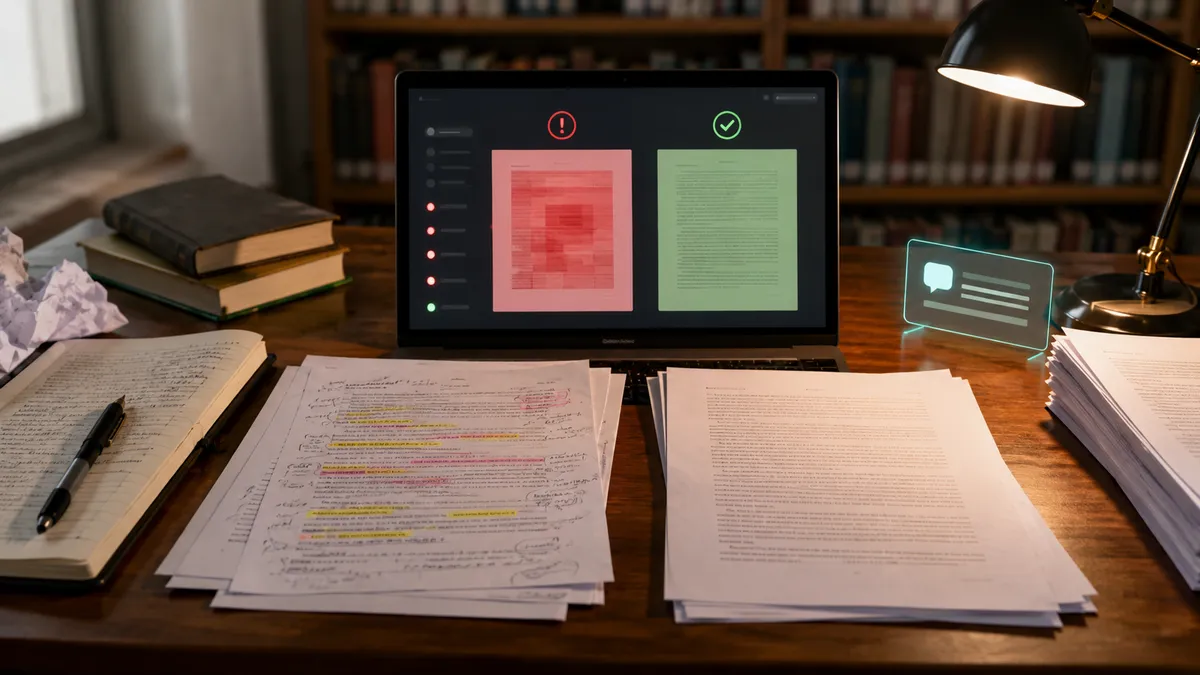
Two students hand in the same essay. One of them wrote every idea in it herself and asked an AI to tidy the prose. The other typed a prompt, pasted the output, and went to the pub. Feed both through a commercial AI detector at the standard threshold and, more often than not, they come back with the same verdict: flagged.
That is not a hypothetical. The new Notre Dame study found exactly this, ("Why AI Detection Fails for Academic Integrity," Karr Jr, Khvatskii, Hua and Chawla), and it's the cleanest bit of receipts I've seen in a while for something a lot of us suspected already: the AI-detection industry is selling universities a number that falls apart the moment anyone checks it against real writing.
The pitch versus the product
Here's what the vendors say about themselves. Pangram claims 99.98% accuracy on AI-generated text with near-zero false positives. GPTZero claims 99.39% in its own peer-reviewed benchmark, and its marketing page rounds that up to 99.76% accuracy with a 0.08% false-positive rate. Numbers like that are why a university compliance office signs the purchase order. Sub-1% error sounds like a solved problem.
Now here's what happened when the researchers ran real, published, peer-reviewed academic abstracts through both tools. Genuine 2023-2025 originals, actual scholarship, no rewriting involved, got flagged 15.0% of the time by Pangram and 8.9% of the time by GPTZero. That's not a rounding error away from the marketing claim. That's the marketing claim living in a different postcode.
The researchers note these recent flag rates can't be confirmed as pure false positives: some 2023-2025 authors may have used AI. But the 2013-2015 baseline, abstracts written years before any of this existed, shows a 0.0% false-positive rate on definitively human text. Which leaves two readings of that 15% and 8.9%, and neither is reassuring: either the detectors can't handle modern scholarship, or modern scholarship has been thoroughly contaminated already. Pick whichever you find more plausible. Both mean the number on the marketing page is doing work it can't back up.
And it gets worse once you introduce a student who's done nothing wrong except ask an AI to polish their own writing. The researchers modelled this with a "refine abstract only" pass, an AI edit that touches phrasing, not substance, meant to stand in for the kind of guideline-compliant assistance most universities technically allow. Flagged 64 to 80% of the time. A student doing exactly what the rulebook permits has roughly the same odds of being accused of cheating as a coin toss weighted against them.
The bit that should really annoy you
Here's the twist that turns this from "flawed tool" into proper catch-22 territory. The researchers also ran the AI-generated rewrites through a humanising service, Undetectable AI, the sort of thing marketed directly at people who want to launder a fully AI-written essay past a detector. After humanising, fewer than 4% of those AI-written texts were still caught. Detection collapsed from "usually works" to "essentially doesn't."
So line the two groups up. The honest student, who used AI for permitted polishing and either disclosed it or had no clear requirement to do so, faces an 80% chance of getting flagged. The dishonest student, who wrote nothing themselves and then paid a subscription to hide it, faces a sub-4% chance of getting caught. The system doesn't just fail to tell these two people apart. It actively sorts them backwards, and punishes the one who did nothing wrong.
Why theology gets flagged and chemistry doesn't
The paper digs into what's actually triggering these scores, and the strongest signal appears to be vocabulary rather than authorship. The two strongest predictors of a high AI score were long-word density and how many words came from the Academic Word List, essentially, "does this sound like formal academic writing." Meanwhile numeric and symbol-heavy text pulled scores down.
Which means a chemistry abstract full of formulas and figures reads as reassuringly human to these tools, while a theology or political science abstract, full of exactly the kind of fluent, multisyllabic academic prose those disciplines are built from, reads as suspicious. In the recent-abstract sample, chemistry got flagged 2.1% of the time. Theology got flagged 26.6% of the time. Same detector, same threshold, same amount of actual AI involvement (none), wildly different verdicts, because the tool is pattern-matching on prose style, not on provenance.
Worth sitting with what that means for the humans on the receiving end too. Non-native English speakers and multilingual students, who tend to lean on AI for exactly this kind of polishing and clarity work, and who often write in a more formal, textbook-derived register to begin with, are the ones most likely to get walked into a misconduct meeting for writing like a good student.
How the humaniser actually does its trick
This is the part I found genuinely interesting, because it's not what you'd guess. You might assume a humanising tool works by chopping sentences up, adding typos, roughing the prose about until it looks messier and more "human." It doesn't. The researchers measured what actually changes and found the opposite: humanised text gets longer, not shorter, and its sentences get longer too.
What it actually strips out is the long-token and Academic Word List density, the exact two features the detectors were keying on in the first place. It's not making the writing sound more human. It's diluting the specific statistical fingerprint the detector was trained to notice, and stretching the sentence length so that fingerprint takes up a smaller share of the text.
That's not humanisation.
That's knowing precisely which two dials the detector is watching and turning them down.
What this means if you're the one being accused
None of this is abstract for anyone currently sitting across a desk from an academic integrity panel while someone holds a Pangram printout like a smoking gun.
The researchers are blunt: a detector score is not proof of misconduct and should not be treated as standalone evidence. It is a statistical guess about writing style, and in this study it could not reliably separate an honest AI-polished text from an untouched human original, let alone from a fully AI-written one that had been through a humanising service.
If your institution's policy is "a flag means a hearing," the policy is the problem, not you.
Any accusation built on a detector score alone deserves the same question put back to it that this paper puts to the detectors themselves: on what basis, exactly, are you so sure?
Steve the Hypothetical Gerbil says: I have never once been asked to write an essay, being a gerbil, but if I were, and I tidied it up a bit afterwards, I'd apparently have worse luck than the fella who got the whole thing written for him and then paid to hide it. Even by the standards of things I've investigated, that is a properly stupid way to run a system.