Kittysupps and the Art of Selling a Crisis That Doesn't Exist
A man in a white coat appears on your Facebook feed. He looks grave. Concerned. The kind of concerned that suggests he has information you need and has been wrestling with his conscience about whether to share it. He has decided to share it.
Commercial pet food, he tells you, is killing your cat.
Specifically, 77 percent of cats are taurine deficient. Your vet knows and is not telling you. The culprit is peas. Lentils. Chickpeas. These ordinary legumes are blocking taurine absorption and quietly destroying your cat’s heart.
Your cat is in danger. You are, through ignorance or inaction, the reason. Unless, of course, you buy the jar.
The Script
I have three cats. Jasper, Tippy, and Larry. All rescues. All resident on a balcony in the Italian Alps. All apparently indifferent to their taurine levels.
When this ad appeared in my feed, I did not feel guilt. I felt recognition.
The man in the white coat is not a vet. He is an actor. You can find his face on stock footage sites and in other supplement ads for other products with other urgent warnings. The white coat is a prop. The grave expression is a performance. The statistic is invented.
The product is called Kittysupps. It contains taurine, an amino acid cats genuinely need and cannot synthesise efficiently. This is well established. Cats have extremely low activity of the enzymes needed to produce taurine internally, as shown in research by Knopf and colleagues in 1978. Taurine is real. The deficiency crisis in cats fed commercial food is not.
But we will get to that.
The 77 Percent Figure
Seventy seven percent is a carefully chosen number. Specific enough to sound like research, vague enough that you cannot place it. It implies a study. It implies data. It implies that someone, somewhere, measured something alarming.
No such study exists.
Taurine deficiency in cats fed properly formulated commercial food is vanishingly rare. The reason is simple. In the 1980s, taurine deficiency was a genuine problem. It caused dilated cardiomyopathy and retinal degeneration in cats. The link between taurine deficiency and heart disease was formally identified in 1987 by Pion and colleagues. Manufacturers responded by increasing taurine levels in commercial diets. The standards were updated. The problem was solved.
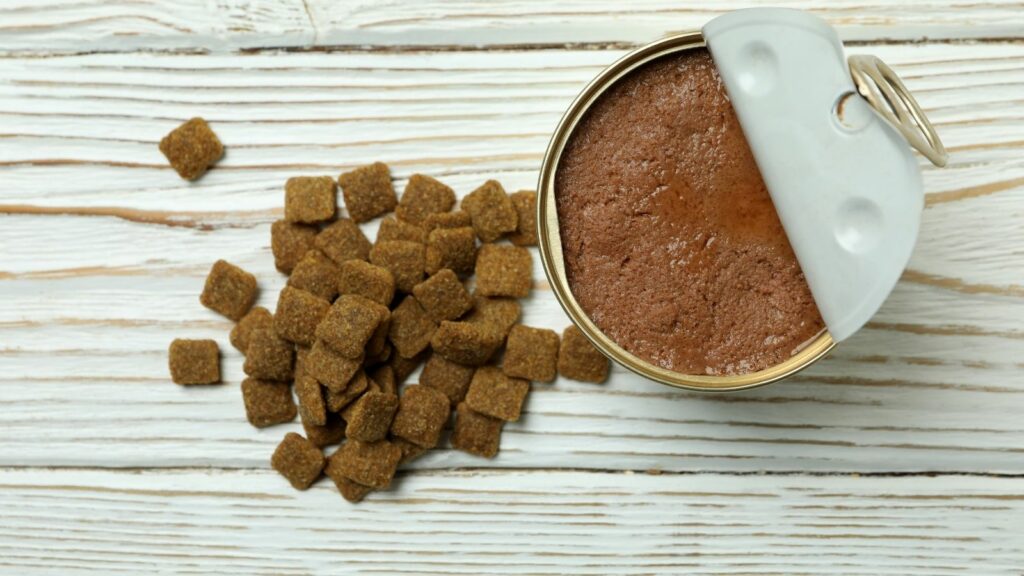
Today, both AAFCO in the United States and FEDIAF in Europe require minimum taurine levels in commercial cat food. AAFCO mandates 0.10 percent taurine in dry food and 0.20 percent in canned food. These requirements exist specifically to prevent the deficiencies seen in the 1980s.
Modern research confirms that the fix worked. A study of 120 healthy adult cats eating commercial diets found normal taurine levels across the population. Dietary ingredients, including plant ingredients, did not correlate with low taurine levels. Age, weight, and body condition score made no meaningful difference.
Deficiency does still occur, but only in predictable situations. Cats fed unbalanced home cooked diets. Cats fed dog food. Cats with specific absorption disorders. Not in ordinary cats eating ordinary kibble from owners who love them enough to worry.
The ad is not targeting people with unusual feeding arrangements. It is targeting everyone. It is manufacturing a crisis that does not exist in order to sell a solution.
The Pea Conspiracy
The claim that peas, lentils, and chickpeas block taurine absorption in cats is not a controversial position. It is not an emerging theory. It is not a minority view held by maverick nutritionists.
It is fiction.
There is no established biochemical mechanism by which legumes interfere with taurine absorption in cats. None. The only vaguely related issue in the literature concerns dogs, where some grain free diets have been suspected of contributing to heart disease. Even that remains unproven and poorly understood. It has nothing to do with cats, taurine, or peas.
The goal is simple. Make ordinary kibble sound dangerous so that the jar sounds necessary.
The pea is not your enemy. It is sitting in your cat’s food doing nothing in particular, as peas generally do.
What Taurine Actually Costs
Here is the detail that puts the whole enterprise in perspective.
Taurine is not rare. It is not exotic. It is not expensive. Pharmaceutical grade taurine from reputable suppliers costs a fraction of a single jar of Kittysupps for an entire year.
You are not paying for taurine. You are paying for the script. You are paying for the white coat. You are paying for the invented statistic. You are paying for the Facebook ads. You are paying for the carefully engineered guilt.
The jar is a prop. The fear is the product.
The Subscription
The jar is not a one-off purchase. It is the entry point to a recurring subscription.
Fear gets you through the door. Inertia keeps you paying. A vague anxiety that cancelling might somehow harm your cat keeps the revenue flowing.
When a brand name accumulates too many complaints or too much regulatory attention, it is quietly retired. A new name appears. The same actor. The same script. The same white coat. The same urgency. The same fear.
This is not incompetence. It is the business model.
The Real Situation
Your cat is almost certainly fine.
If you are genuinely concerned about taurine levels, your vet can check them with a blood test. This is the appropriate response to a genuine health concern. Not a Facebook ad. Not a jar from a company whose address, if it appears at all, leads to a jurisdiction chosen for its distance from consumer protection enforcement.
If supplementation is actually needed, for a diagnosed deficiency, a home cooked diet, or a specific medical condition, pharmaceutical grade taurine is available cheaply and safely. Your vet can advise on dosage.
The man in the white coat cannot advise on anything. His concern for your cat was negotiated before filming.
The Mechanism
Fear is the product. Your love for your cat is the distribution channel. The subscription is the point.
Everything else, the statistic, the conspiracy, the pea blocking mechanism, the grave whistleblower, is infrastructure. It exists to move you from the Facebook feed to the checkout page before the part of your brain that asks questions catches up with the part that loves your cat.
Jasper, Tippy, and Larry would like you to know they are fine. They are warm, fed, occasionally unreasonable, and have never once expressed concern about their taurine levels.
Your cat is probably the same.
Further Reading


Paul is 71, writes from the Italian Alps, and shares his balcony with three rescue cats who have opinions about birds but not about supplements.
Comments ()